Why Cu²⁺ : Peptide Ratio Matters — A 90-Second Quality Check for Formulators. Read our briefing →
Why Cu²⁺ Ratio Matters — a field guide. Read →
On the Cu²⁺ ratio. Read →
Cupratec is the atelier behind copper-bound peptide actives for cosmetic, dermatology, hair-scalp, and licensed mesotherapy programmes. Every lot leaves our bench with a UV-Vis spectrum, a measured Cu²⁺ : peptide molar ratio, and solution-stability data — because copper coordination is a chemistry problem, not a catalogue SKU.
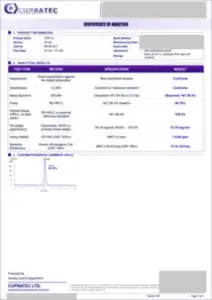
UV-Vis · Illustrative GHK-Cu lot
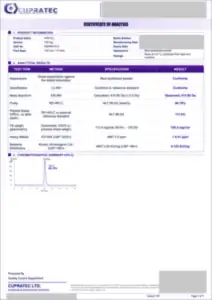
GHK-Cu · Lot CT-26-A0517
CAS
89030-95-5
MW (complex)
401.91
Cu : Pep
1.00 ± 0.02
Per Lot
UV-Vis + Cu²⁺ ratio
g-scale
Atelier batches
<12h
Response
The Cupratec Atelier Promise — On Every Lot
Inside the Atelier · Two Actives
Cupratec carries only the copper-peptide actives whose coordination chemistry we have fully characterised. Two molecules, each with its own per-lot UV-Vis spectrum and measured Cu²⁺ : peptide ratio.
Active · Cu(II) tripeptide
Dermal · anti-ageingCopper Tripeptide-1 · the textbook copper-bound tripeptide
CAS 89030-95-5 · MW 401.91 · Purity ≥ 99.0%
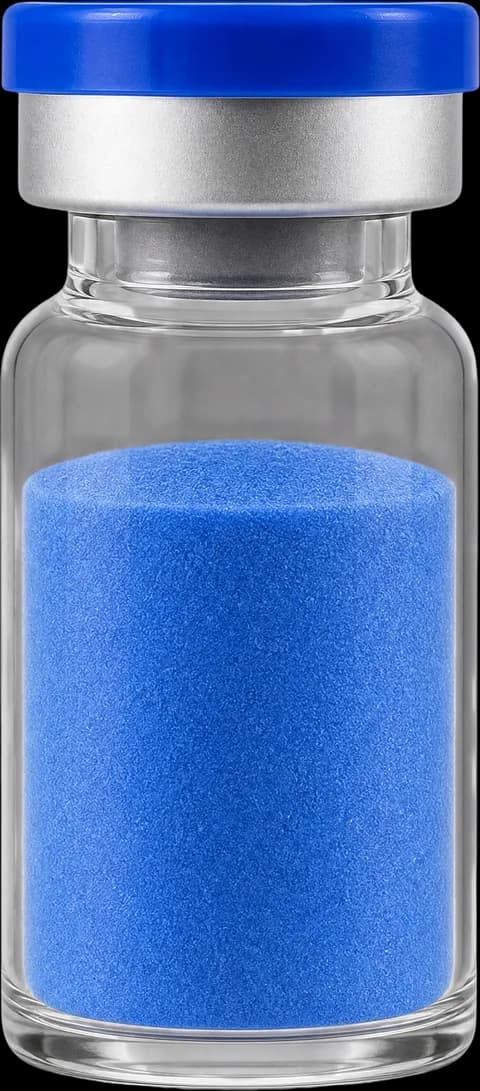
The reference Cu(II)-tripeptide complex — Gly-His-Lys coordinated 1:1 to a divalent copper ion through the histidine imidazole and two backbone amides, forming the square-planar tetraamine field that gives the powder its diagnostic blue. Cupratec releases GHK-Cu only when the lot has cleared its UV-Vis spectrum, Cu²⁺ : peptide ratio, and 6-month solution-stability data — the same packet that travels with the vial.
Active · Cu(II) tripeptide
Scalp · hair-careCopper-bound Ala-His-Lys · the copper active for scalp and hair-care work
Sequence AHK · 1:1 Cu²⁺ complex · Purity ≥ 99.0%
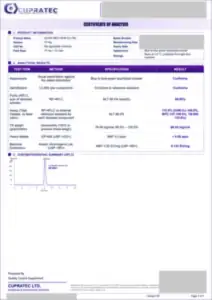
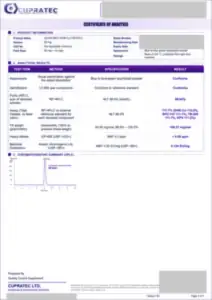
The structural analog to GHK-Cu, with the N-terminal glycine swapped for alanine — the substitution reshapes the geometry around the copper, which is why the cosmetic literature associates AHK-Cu most often with scalp and hair-care formulation. We supply it strictly as a cosmetic active. Same atelier discipline: every lot ships with its UV-Vis trace, measured Cu²⁺ ratio, and a stability dataset against the master lot.
A copper-peptide specialist by design: every active here is coordinated and released in-house against the full Cu²⁺ panel — molar ratio, the ~622 nm d-d band, and colour ΔE against the master lot. Need a copper peptide beyond the catalogue?
Inside the Atelier
Beyond the two characterised actives, Cupratec runs an atelier of method, custom synthesis, and editorial — pick the doorway that matches what your formulation programme needs next.
How we coordinate the copper, hold the complex through purification, and prove it on every single lot — the atelier methodology behind the two actives.
Editorial briefs for formulators — why the Cu²⁺ ratio matters, how to read a Cu-peptide UV-Vis spectrum, formulation guardrails for the working window.

Lot-release bench · captured during a production day
Lot Data, on Every Lot
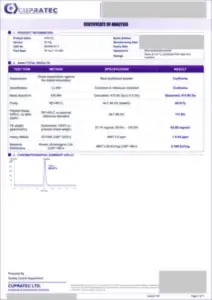
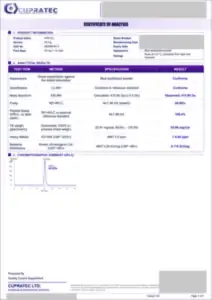
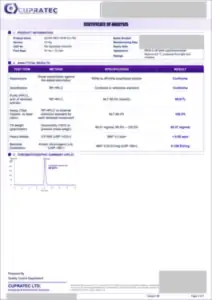
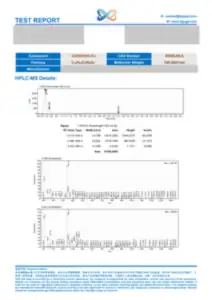
A GHK-Cu lot without a UV-Vis spectrum is just a blue powder. Every Cupratec lot ships with the characterisation data formulators actually need — and the analytical packet behind it on request.
≈622 nm
λmax · Cu(II) d-d band
ΔE < 1.0
Color vs. master lot
6-month
Solution stability data
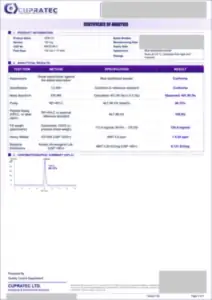
UV-Vis spectrum on every lot — λmax position and absorbance at brand-relevant wavelengths, the diagnostic for intact Cu(II) coordination.
Cu²⁺ : peptide molar ratio by ICP-MS or atomic absorption, target with documented tolerance — never assumed from synthesis stoichiometry.
Solution stability + color ΔE, tracked through 6 months at 25 / 40 / 60 °C against an in-house master-lot reference.
Field Notes
Short, chemistry-literate pieces for formulators who already know what GHK-Cu is and need to know how to read its lot data.
Published June 2, 2026
7 min read
Both carry cosmetic copper into a collagen-support brief, but one wraps Cu(II) in a histidine-anchored tripeptide pocket and the other in a pair of free amino acids. The ligand difference reshapes the colour, the solubility, the stability envelope, and the release file. Why a copper-chemistry house documents them as two distinct actives rather than one copper.
Read the Field Note
Case Studies
Anonymized accounts of how med-aesthetic brands, clean-beauty labels, formulators, and contract manufacturers source copper-bound peptide actives — every name removed, the coordination chemistry and documented outcome kept intact.
A multi-location EU aesthetic-medicine group wanted a retail copper-peptide serum under its own clinic brand but had no formulation or notification capability in-house. The private-label workflow carried it from signed brief to first shipment inside the window the launch needed.
Signed brief → first shipment
Inside the launch window
CPNP chemistry file
Cleared without a rework round
Stability programme
Real-time + accelerated
Reorder match
Coordination held across lots
Read the story
A small clean-beauty label had built a GHK-Cu serum around a 'no synthetic chelators' promise, then watched the colour drift between batches. The fix was upstream — a documented coordination state to formulate against, and the chemistry reasoning to rebuild the carrier.
Per-lot data
UV-Vis + Cu²⁺ : peptide ratio
Colour control
Held to a master swatch
Root cause
Isolated to carrier, not active
Clean-claim
Kept, coordination intact
Read the story
A contract manufacturer making a copper-peptide serum for a brand client needed an active whose documentation survived inspection twice — its own incoming check and the client's audit of the finished good. The qualification turned on copper-quantification method and re-auditable lot data.
Lot data
Re-auditable at client QC
Copper method
Agreed before first lot
Coordination
Evidenced, not assumed
Supply
Schedulable across the run
Read the story
From the Atelier
First response under 12 hours. We send a 25 g sample of the active you specify, the lot's UV-Vis spectrum, the Cu²⁺ : peptide ratio measurement, and a feasibility note for the formulation application you have in mind.